

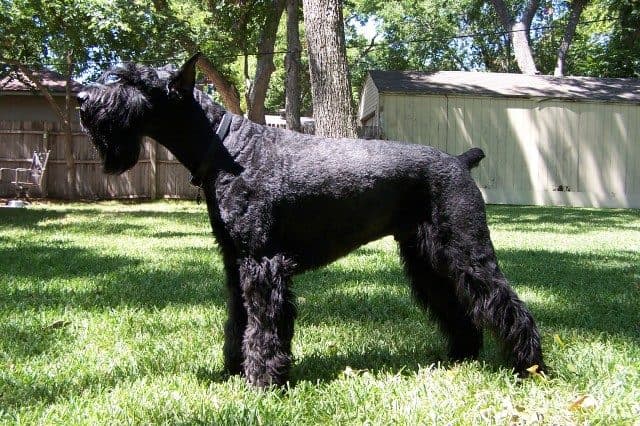
Schnauzer Gigante
The largest of the three schnauzers. A traditional German guardian. Balanced, loyal and watchful temperament. Hypoallergenic. Needs firm training.
Foto: Wikipedia Commons · CC BY-SA
Ideal for
- ✓Very active families with experience
- ✓Homes with a garden
- ✓Allergy sufferers
Reconsider if
- ×Flats without exercise
- ×Beginners
Notify me when a Schnauzer Gigante is up for adoption
We'll only email you when a verified rescue posts one available. No spam, unsubscribe in 1 click.
We'll only use your email for this alert. More info in our privacy policy.
Is the Schnauzer Gigante a good match for you?
Indicative rating from 1 (low) to 5 (high).
💶 Estimated cost of ownership
75-130 €/month
Food for large breeds €40-65; grooming with hand-stripping (pro-rated) €15-25; parasite control €12-20; pro-rated vaccinations and check-ups €18-28. Its size makes medication and anaesthesia more expensive.
History and origin
Germany, 15th-16th century, a large farm dog from Bavaria and Württemberg. Guardian of the beer carts. Re-established at the start of the 20th century.
Recognised by the FCI within Group 9 (companion dogs). Its small size makes flat living easier, but "small" is not synonymous with "needs no training": small dog syndrome (excessive barking, fearfulness, reactivity) is common when it is not given the same routine as a large dog.
Temperament and character
Balanced, watchful and loyal. Devoted to its family. Reserved with strangers. Intelligent and hard-working. It needs daily mental stimulation — scent games, food-stuffed Kongs and short trick sessions channel its energy better than physical exercise alone. It responds best to positive reinforcement: physical punishment creates fear, anxiety and reactivity — coercive methods are NOT recommended by veterinary behaviourists. Sensitive to its family's mood: it picks up on tension and mirrors it.
Living together
Children: good with its own. Other dogs: dominant with the same sex. Cats: with socialisation.
Life stages of the Schnauzer Gigante
Each stage has its own care priorities. Life expectancy: 11-13 años.
Puppy
0-1 year
Socialisation and early obedience (a dominant, working breed); controlled bone growth.
Young
1-2 years
Plenty of physical and mental exercise; hip radiographs; thyroid baseline; wiry coat management (hand-stripping).
Adult
2-7 years
Split meals (gastric torsion); thyroid monitoring; retinal examination; monitoring for digital tumours.
Senior
7+ years
Monitoring for tumours (digital carcinoma, osteosarcoma); thyroid, eye and joint monitoring.
Care
Exercise: 60-90 min/day split into at least 2 sessions. Off-lead time in a safe area is essential for high-energy breeds.
Brushing: daily; intensive during moulting (spring and autumn).
Feeding: quality food matched to its life stage (puppy/adult/senior) and size. Weight control: obesity is the leading avoidable cause of joint problems.
Vet: annual check-up with preventive blood tests from age 5 (age 7 in giants); twice a year from age 8.
Exercise 1.5-2 h/day. Weekly brushing plus hand-stripping every 2 months. Beard cleaning. Firm, positive training.
Care in detail
🍽️ Nutrition
Quality food for large active breeds, adjusted to its high energy expenditure. Ration split into 2 meals with rest afterwards to reduce the risk of gastric torsion.
✂️ Grooming
Wiry coat that requires hand-stripping every 2 months and weekly brushing; it sheds very little. Clean the beard after eating and drinking to avoid odours and infections.
🎓 Training
Highly intelligent and hard-working; it needs firm, positive training and early socialisation. It is a guardian that requires experience and a constant occupation.
🏃 Exercise
Very high: 1.5-2 hours daily of physical and mental exercise. Without enough activity it develops problem behaviours.
Breed-specific health
Dysplasia. Bloat. Hypothyroidism. Cataracts. Cancer. Life expectancy 11-13 years. Life expectancy 11-13 years with proper care. Pre-breeding tests recommended at responsible breeders (dysplasia + cardiac + ophthalmology depending on the breed's conditions). When adopting, ask the shelter for a vet report on the current state of health.
🩺 Health predispositions of this breed
Conditions this breed is more predisposed to. Knowing about them helps with prevention and early detection. A predisposition does not mean the animal will develop them.
Common diseases in dogs
Learn the symptoms, prevention and when to see the vet. Reviewed indicative information that does not replace a veterinary consultation.
Screening and prevention for the Schnauzer Gigante
Recommended tests and screenings
- ✓Hip and elbow dysplasia radiographs
- ✓Thyroid function (T4/TSH)
- ✓Ophthalmological examination (cataracts)
- ✓Echocardiography
- ✓Full blood count and biochemistry
Prevention
Plenty of exercise and mental work for its high energy; split meals with rest afterwards to guard against bloat; weight control, thyroid monitoring and checking of the skin and toes given its predisposition to tumours.
Check-up schedule
Annual check-up with blood tests and thyroid profile; periodic joint and eye monitoring.
Warning signs
- !Swollen abdomen with unproductive retching (gastric torsion, emergency)
- !Lameness or stiffness after exercise
- !Lethargy, weight gain or hair loss (hypothyroidism)
- !Skin lumps or swelling of a toe (possible tumour)
- !Cloudy vision or an opaque eye (cataracts)
Schnauzer Gigante gallery

Frequently asked questions about the Schnauzer Gigante
- How long does a Schnauzer Gigante live? ▾
- The life expectancy of the Schnauzer Gigante is 11-13 años. A good diet, adequate exercise, annual veterinary check-ups and preventive care can help reach the upper end of that range.
- How much does a Schnauzer Gigante weigh? ▾
- An adult Schnauzer Gigante weighs between 32-48 kg, depending on its sex, genetics and condition. It is grande.
- Where does the Schnauzer Gigante breed come from? ▾
- The Schnauzer Gigante originates from Alemania. Germany, 15th-16th century, a large farm dog from Bavaria and Württemberg. Guardian of the beer carts. Re-established at the start of the 20th century.
- How much exercise does a Schnauzer Gigante need? ▾
- The Schnauzer Gigante has alta energy. **Exercise:** 60-90 min/day split into at least 2 sessions. Off-lead time in a safe area is essential for high-energy breeds.
- Is the Schnauzer Gigante good with children? ▾
- Children: good with its own. Other dogs: dominant with the same sex. Cats: with socialisation.
- Who is the Schnauzer Gigante NOT recommended for? ▾
- It isn't the right breed for: Flats without exercise. Beginners. It's important to choose a breed that's compatible with your lifestyle.
- What health problems does the Schnauzer Gigante have? ▾
- Dysplasia. Bloat. Hypothyroidism. Cataracts. Cancer. Life expectancy 11-13 years. Life expectancy 11-13 years with proper care. Pre-breeding tests recommended at responsible breeders (dysplasia + cardiac + ophthalmology depending on the breed's conditions). When adopting, ask the shelter for a vet report on the current state of health.
- Is it hypoallergenic? ▾
- Its wiry coat barely sheds and produces little dander, so it is usually tolerated better than other breeds, although no dog is 100% hypoallergenic.
- Is it suitable for beginners? ▾
- It is not the best choice. It is a large, strong, intelligent guarding dog that needs an experienced owner with time to train it.
- How much exercise does it need? ▾
- A lot: 1.5-2 hours daily of physical exercise and mental work. It does not fit sedentary households or flats without activity.
- How often does it need hand-stripping? ▾
- Roughly every two months, in addition to weekly brushing. Hand-stripping keeps the coat's wiry texture; clipping softens it.
- Is it a good guard dog? ▾
- Excellent. It is watchful, loyal and a deterrent because of its size, but it needs socialisation to properly distinguish situations of real threat.
Related and similar breeds
Learn more about dogs
Practical veterinary guides to support your Schnauzer Gigante.
Sources and references
Content compiled from official breed standards and leading veterinary sources.
Want to adopt a schnauzer gigante?
There are schnauzer gigantes in rescue shelters looking for a family. Filter by breed in the catalogue.