

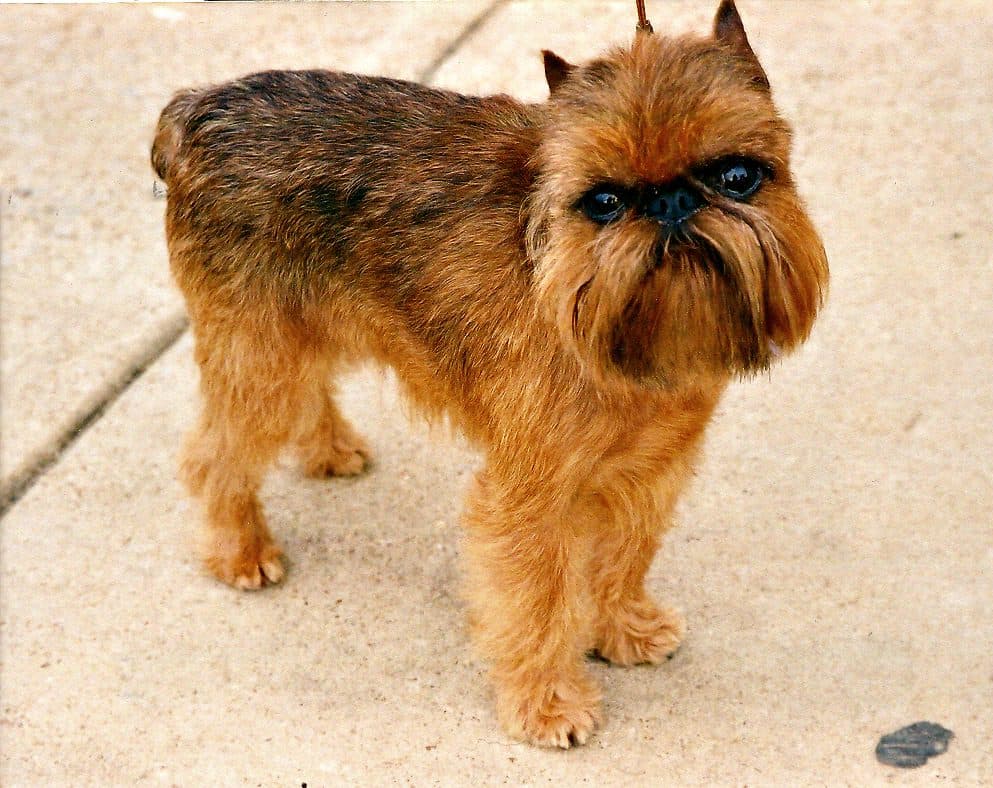
Brussels Griffon (Grifón Belga)
Belgian toy with an expressive "monkey-like" face — the inspiration behind Star Wars' Ewoks. Three varieties: Bruxellois, Belge and Petit Brabançon. Affectionate.
Foto: Wikipedia Commons · CC BY-SA
Ideal for
- ✓Small flats
- ✓Older people
- ✓Quiet urban families
Reconsider if
- ×Very young children (fragile)
Notify me when a Brussels Griffon (Grifón Belga) is up for adoption
We'll only email you when a verified rescue posts one available. No spam, unsubscribe in 1 click.
We'll only use your email for this alert. More info in our privacy policy.
Is the Brussels Griffon (Grifón Belga) a good match for you?
Indicative rating from 1 (low) to 5 (high).
💶 Estimated cost of ownership
45-75 €/month
Food 18-30 €, grooming/stripping (rough variety) 10-20 € prorated, antiparasitics 8-12 €, veterinary allowance 15-25 €. Set aside a fund for the eyes and possible caesarean births if breeding.
History and origin
Recognised by the FCI. Originating in Belgium (Brussels). A Belgian toy with an expressive "monkey-like" face — the inspiration behind Star Wars' Ewoks.
Temperament and character
Intelligent, loyal and well-balanced when properly socialised and trained. Needs daily mental stimulation. Responds best to positive reinforcement. Physical punishment breeds fear and reactivity.
Living together
Children: with older, careful children (fragile). **Other dogs:** fine with those of similar size. **Cats:** usually cohabits well.
Life stages of the Brussels Griffon (Grifón Belga)
Each stage has its own care priorities. Life expectancy: 12-15 años.
Puppy
0-12 months
Socialisation; protecting the large eyes and monitoring the brachycephalic airway; careful handling due to its small size.
Young adult
1-3 years
Moderate exercise avoiding heat; eye and coat care.
Adult
3-8 years
Respiratory, ocular (ulcers, proptosis) and patellar monitoring; weight control.
Senior
8+ years
Respiratory, eye and dental check-ups; senior diet and gentle exercise during cool hours.
Care
Exercise: 30-45 min/day.
Brushing: according to coat type.
**Dental hygiene critical.
Vet: annual check-up + attention to patellar luxation.
Care in detail
🍽️ Nutrition
Good-quality small-kibble food suited to its mouth; measured portions, as it gains weight easily and excess weight worsens breathing and the patella.
✂️ Grooming
Depending on the variety: the rough-coated type (Bruxellois/Belge) needs hand-stripping and brushing 2-3 times a week; the smooth-coated type (Petit Brabançon) needs weekly brushing. Frequent dental hygiene.
🎓 Training
Intelligent, sensitive and very attached ('velcro dog'): positive reinforcement and socialisation to prevent fears. House-training can be tricky.
🏃 Exercise
30-45 minutes daily of walking and play, avoiding exertion during hot hours; small but curious, it enjoys light activity and companionship.
Breed-specific health
Conditions commonly seen in the breed according to its FCI group. Life expectancy 12-15 years with appropriate care. Annual vet check-up + blood work from 5 years of age.
🩺 Health predispositions of this breed
Conditions this breed is more predisposed to. Knowing about them helps with prevention and early detection. A predisposition does not mean the animal will develop them.
Common diseases in dogs
Learn the symptoms, prevention and when to see the vet. Reviewed indicative information that does not replace a veterinary consultation.
Screening and prevention for the Brussels Griffon (Grifón Belga)
Recommended tests and screenings
- ✓Airway assessment (brachycephalic syndrome, mild to moderate)
- ✓Patellar luxation assessment
- ✓Ophthalmological examination (corneal ulcers, cataracts due to prominent eyes)
- ✓MRI if syringomyelia/Chiari-like malformation is suspected
Prevention
Avoid heat and strenuous exercise because of its flat face, maintain rigorous dental hygiene due to its small mouth, and protect its prominent eyes. Keep vaccinations and deworming up to date.
Check-up schedule
Annual check-up with emphasis on mouth, eyes and breathing; two visits a year from 8 years of age.
Warning signs
- !Noisy breathing, choking or intolerance to heat/exercise (airways)
- !Red, squinting or watery eye (possible corneal ulcer, an emergency)
- !Skipping on a hind leg or intermittent hind-limb lameness (patella)
- !Air-scratching at the neck/shoulder or pain when the head is touched (syringomyelia)
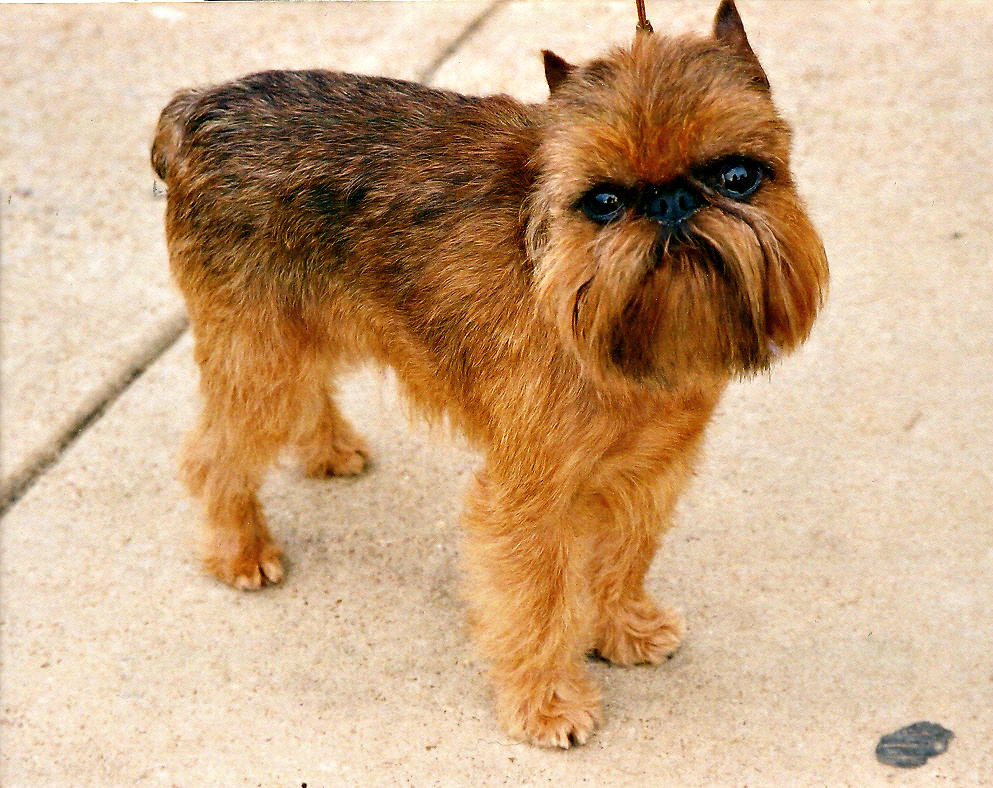
Brussels Griffon (Grifón Belga) gallery
Frequently asked questions about the Brussels Griffon (Grifón Belga)
- How long does a Brussels Griffon (Grifón Belga) live? ▾
- The life expectancy of the Brussels Griffon (Grifón Belga) is 12-15 años. A good diet, adequate exercise, annual veterinary check-ups and preventive care can help reach the upper end of that range.
- How much does a Brussels Griffon (Grifón Belga) weigh? ▾
- An adult Brussels Griffon (Grifón Belga) weighs between 4-6 kg, depending on its sex, genetics and condition. It is toy.
- Where does the Brussels Griffon (Grifón Belga) breed come from? ▾
- The Brussels Griffon (Grifón Belga) originates from Bélgica (Bruselas). Recognised by the FCI. Originating in Belgium (Brussels). A Belgian toy with an expressive "monkey-like" face — the inspiration behind Star Wars' Ewoks.
- How much exercise does a Brussels Griffon (Grifón Belga) need? ▾
- The Brussels Griffon (Grifón Belga) has media energy. **Exercise:** 30-45 min/day.
- Is the Brussels Griffon (Grifón Belga) good with children? ▾
- **Children:** with older, careful children (fragile). **Other dogs:** fine with those of similar size. **Cats:** usually cohabits well.
- Who is the Brussels Griffon (Grifón Belga) NOT recommended for? ▾
- It isn't the right breed for: Very young children (fragile). It's important to choose a breed that's compatible with your lifestyle.
- What health problems does the Brussels Griffon (Grifón Belga) have? ▾
- Conditions commonly seen in the breed according to its FCI group. Life expectancy 12-15 years with appropriate care. Annual vet check-up + blood work from 5 years of age.
- Does it have breathing problems like other flat-faced dogs? ▾
- To a mild-to-moderate degree. Its short muzzle can cause snoring and intolerance to heat and intense exercise, though it is usually less affected than the bulldog or the pug. Avoid heat and excess weight.
- Is it delicate with children? ▾
- It is very fragile because of its small size and can be injured by rough play. It fits best in households of adults or with older, careful children; with little ones it requires constant supervision.
- Why do its eyes need so much care? ▾
- Its large, prominent eyes are highly exposed to knocks, dryness and corneal ulcers. A red, squinting or watery eye is grounds for an urgent visit.
- Does it shed a lot? ▾
- Little. The rough-coated variety barely sheds but needs stripping; the smooth-coated one sheds a bit more. In both cases the upkeep is manageable.
- Does it adapt to a small flat? ▾
- Perfectly. It is an ideal toy for urban life and for older people, with little exercise requirement. You just have to accept its strong attachment: it does not cope well with prolonged solitude.
Learn more about dogs
Practical veterinary guides to support your Brussels Griffon (Grifón Belga).
Sources and references
Content compiled from official breed standards and leading veterinary sources.
Want to adopt a brussels griffon (grifón belga)?
There are brussels griffon (grifón belga)s in rescue shelters looking for a family. Filter by breed in the catalogue.