

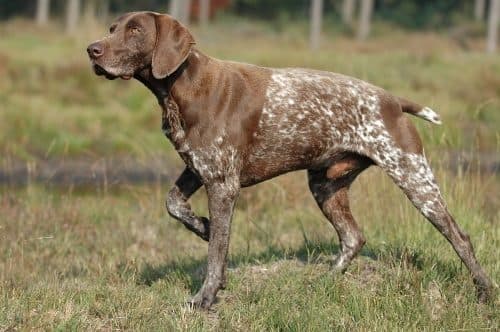
Braco Alemán
A versatile German gundog (Deutsch Kurzhaar). A multifunctional athlete: it tracks, points and retrieves from water and land. Active, intelligent and balanced temperament.
Foto: Wikipedia Commons · CC BY-SA
Ideal for
- ✓Hunters
- ✓Sports enthusiasts (canicross, agility)
- ✓Very active families
Reconsider if
- ×Sedentary families
- ×Flats without exercise
- ×Homes where it is alone for many hours
Notify me when a Braco Alemán is up for adoption
We'll only email you when a verified rescue posts one available. No spam, unsubscribe in 1 click.
We'll only use your email for this alert. More info in our privacy policy.
Is the Braco Alemán a good match for you?
Indicative rating from 1 (low) to 5 (high).
💶 Estimated cost of ownership
70-115 €/month
Food 40-60 €, antiparasitics 12-18 €, veterinary fund 18-28 €, sport/accessories 5-10 €. Easy coat = little grooming cost; the main cost is exercise time.
History and origin
Created in Germany in the 19th century as an all-round hunting dog, crossing the Spanish pointer, scent hounds and the Pointer. Standardised in 1879.
Recognised by the FCI within Group 7 or 8 (pointing or retrieving dogs). Its historic hunting use determines its need for physical exercise and scent work: boredom is the main cause of behavioural problems.
Temperament and character
Active, intelligent and loyal. Attached to its family. Needs a daily "job". Sociable. Needs daily mental stimulation — scent games, food Kongs and short tricks channel its energy better than physical exercise alone. Responds best to positive reinforcement: physical punishment generates fear, anxiety and reactivity — coercive methods are NOT recommended by veterinary behaviourists. Sensitive to its family's mood: it picks up on tension and takes it on.
Living together
Children: excellent. Other dogs: sociable. Cats: with socialisation.
Life stages of the Braco Alemán
Each stage has its own care priorities. Life expectancy: 12-14 años.
Puppy
0-1 year
Socialisation and progressive exercise; channelling its very high energy; hygiene of the drop ears.
Young
1-2 years
Huge demand for physical and mental exercise; hip radiographs; clotting and thyroid tests.
Adult
2-8 years
Split meals and post-meal rest (gastric torsion risk); ear cleaning; weight control.
Senior
8+ years
Thyroid and joint check; digestive monitoring; keep exercise adapted to its vitality.
Care
Exercise: 90-120 min/day split into at least 2 sessions. Off-lead time in a secure area is essential for high-energy breeds.
Brushing: 2-3 times/week; intensive during moulting (spring and autumn).
Feeding: quality food suited to life stage (puppy/adult/senior) and size. Weight control: obesity is the main avoidable cause of joint problems.
Vet: annual check-up with preventive blood work from age 5 (age 7 in giant breeds); twice a year from age 8.
Exercise 2 h/day plus mental stimulation. Easy short coat. Positive training. Company: it suffers when left alone.
Care in detail
🍽️ Nutrition
Quality food for a large sporting dog, split into 2-3 meals (bloat prevention) and adjusted to its very high energy expenditure.
✂️ Grooming
A short, hard coat that is very easy to maintain: weekly brushing. Water- and weather-resistant.
🎓 Training
Brilliant, hard-working and highly trainable: ideal for hunting and dog sports (canicross, agility). Positive reinforcement; bored or alone, it becomes destructive.
🏃 Exercise
2 hours or more of daily intense exercise and mental work; one of the most energetic dogs, completely unsuited to a sedentary or flat-based life without activity.
Breed-specific health
Dysplasia. Retinal atrophy. Lupus. Bloat. Lymphoedema. Life expectancy 12-14 years. Life expectancy 12-14 years with proper care. Pre-breeding tests recommended in responsible kennels (dysplasia + cardiac + ophthalmology according to the breed's conditions). When adopting, ask the shelter for a vet report on the current condition.
🩺 Health predispositions of this breed
Conditions this breed is more predisposed to. Knowing about them helps with prevention and early detection. A predisposition does not mean the animal will develop them.
Common diseases in dogs
Learn the symptoms, prevention and when to see the vet. Reviewed indicative information that does not replace a veterinary consultation.
Screening and prevention for the Braco Alemán
Recommended tests and screenings
- ✓Official hip radiograph (dysplasia)
- ✓Genetic test/ophthalmological examination for progressive retinal atrophy
- ✓Von Willebrand disease test (clotting)
- ✓Monitoring for gastric dilatation-volvulus (bloat) and eyelid examination (entropion)
Prevention
A huge amount of exercise and mental stimulation, split meals to prevent bloat, and company to avoid separation anxiety. Keep vaccinations and deworming up to date.
Check-up schedule
Annual check-up with blood work from age 5; two visits a year from age 8.
Warning signs
- !Distended abdomen with unproductive retching (bloat: LIFE-THREATENING EMERGENCY)
- !Stumbling or loss of night vision (PRA)
- !Abnormal bleeding or bruising (von Willebrand)
- !Destruction, barking or anxiety when left alone
Braco Alemán gallery

Frequently asked questions about the Braco Alemán
- How long does a Braco Alemán live? ▾
- The life expectancy of the Braco Alemán is 12-14 años. A good diet, adequate exercise, annual veterinary check-ups and preventive care can help reach the upper end of that range.
- How much does a Braco Alemán weigh? ▾
- An adult Braco Alemán weighs between 20-32 kg, depending on its sex, genetics and condition. It is grande.
- Where does the Braco Alemán breed come from? ▾
- The Braco Alemán originates from Alemania. Created in Germany in the 19th century as an all-round hunting dog, crossing the Spanish pointer, scent hounds and the Pointer. Standardised in 1879.
- How much exercise does a Braco Alemán need? ▾
- The Braco Alemán has muy alta energy. **Exercise:** 90-120 min/day split into at least 2 sessions. Off-lead time in a secure area is essential for high-energy breeds.
- Is the Braco Alemán good with children? ▾
- Children: excellent. Other dogs: sociable. Cats: with socialisation.
- Who is the Braco Alemán NOT recommended for? ▾
- It isn't the right breed for: Sedentary families. Flats without exercise. Homes where it is alone for many hours. It's important to choose a breed that's compatible with your lifestyle.
- What health problems does the Braco Alemán have? ▾
- Dysplasia. Retinal atrophy. Lupus. Bloat. Lymphoedema. Life expectancy 12-14 years. Life expectancy 12-14 years with proper care. Pre-breeding tests recommended in responsible kennels (dysplasia + cardiac + ophthalmology according to the breed's conditions). When adopting, ask the shelter for a vet report on the current condition.
- How much exercise does it really need? ▾
- A huge amount: 2 hours or more a day of intense activity plus mental stimulation. It is a tireless multifunctional athlete; without that outlet it becomes frustrated and destructive. It is not a dog for a quiet life.
- Does it cope well with being left alone? ▾
- No. It is very attached to its family and suffers separation anxiety if left alone for many hours. It needs company and to be part of the household's daily life.
- Is it good with children? ▾
- Excellent: balanced, playful and affectionate with its own. Its energy and size call for supervision with small children to avoid accidental knocks during play.
- What is von Willebrand disease? ▾
- It is an inherited clotting disorder present in the breed that can cause abnormal bleeding. A genetic test detects it; it is important to know before any surgery.
- Is it suited to living in a flat? ▾
- Only if the family is very sporty and guarantees hours of daily exercise outside. Even so, its energy makes a home with space and an active routine much more suitable.
Related and similar breeds
Learn more about dogs
Practical veterinary guides to support your Braco Alemán.
Sources and references
Content compiled from official breed standards and leading veterinary sources.
Want to adopt a braco alemán?
There are braco alemáns in rescue shelters looking for a family. Filter by breed in the catalogue.